
EXIT stories with Andrew Lockhead & Simon Boulet (Stay22)
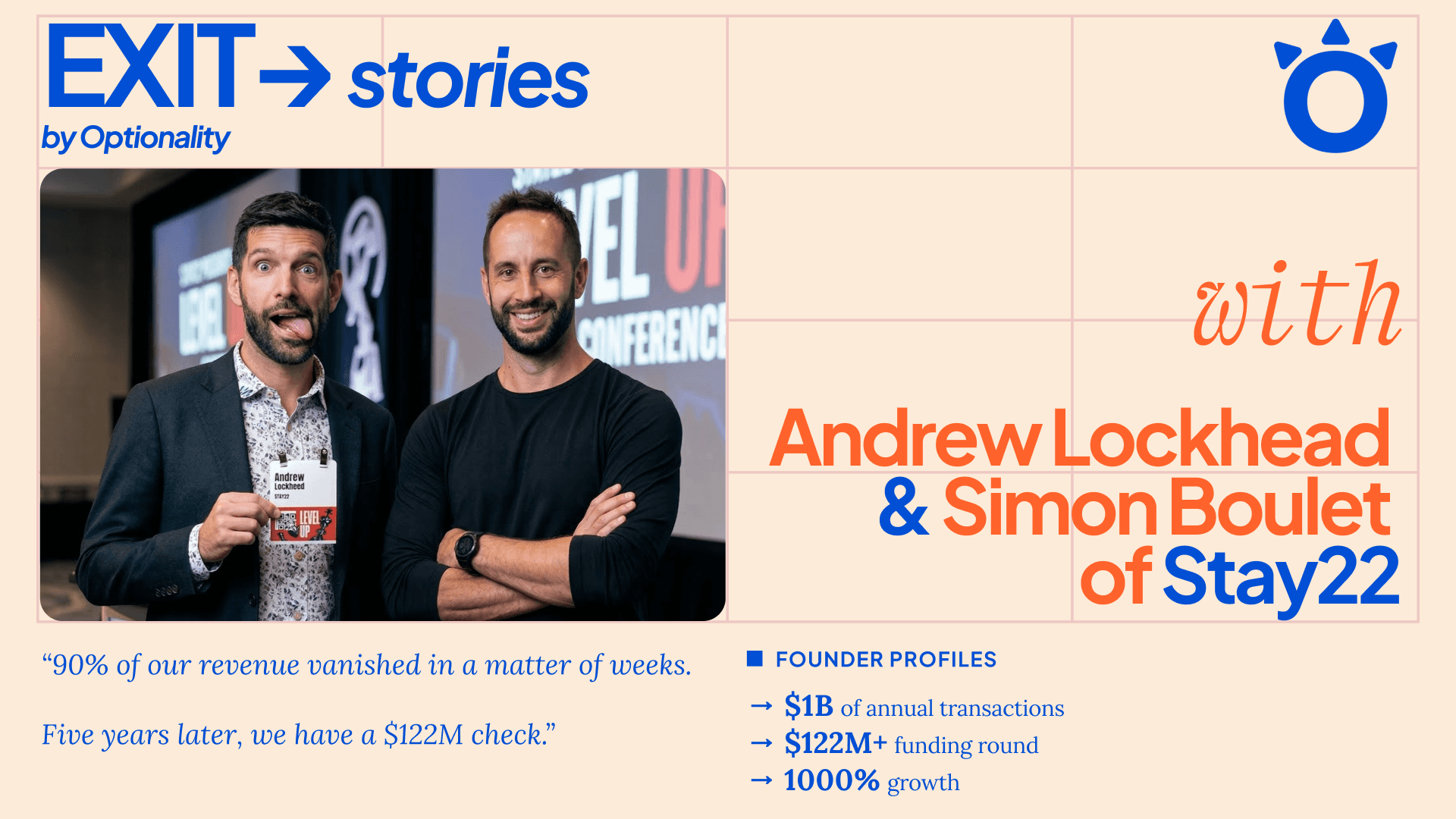
Lessons Learned From a $122M Deal (with Andrew Lockhead & Simon Boulet)
For our second EXIT Stories, I sat down with Andrew Lockhead and Simon Boulet, the CEO and COO of Stay22, a travel-tech company that turns content into bookings for thousands of creators and publishers.
Stay22 closed a $122 million investment from Summit Partners. It's the kind of number that looks clean from the outside: a Quebec company that made it.
The real story is less tidy. Behind that headline are roughly six pivots and a near-bankruptcy. That's exactly why we created EXIT Stories: to talk about what actually happens behind the headline, founder to founder. Not just the wins, but the scars.
Here's what Andrew and Simon shared.
The making of the transaction
Stay22 is almost ten years old. It started as a B2C2C product in the events space, an interactive map that let attendees book accommodation around events like C2 Montréal. Since then, the company has been through about six pivots.
The team has a nickname for itself: cockroaches.
Not the most flattering label, but it captures something real.
There's a will in this company to refuse to die. Every time someone gets comfortable, someone else shakes them out of it. (Simon Boulet)
They had no shortage of moments that could have ended them.
On March 11, 2020, the pandemic hit. Within weeks, revenue fell from $110,000+ a month to roughly $10,000. The team shrank from 24 people to 8. Two investors who were supposed to wire their cheques walked away. Andrew and Simon decided then that they would control their own destiny rather than wait on money that might never come.
They succeeded in surviving Covid and rebuilding revenue. But that was not it.
Exactly one year later, on March 11, 2021, Airbnb cut off Stay22's API access, at the time about 80% of the bookings.
What could have killed them became their product. In cutting Stay22, Airbnb had also cut off the thousands of content creators who monetized their travel recommendations. Stay22 still had access to the rest of the inventory (Booking Holdings, Expedia, Vrbo), so it built a solution for those creators. That pivot is what finally produced product-market fit in this segment.
Andrew describes the shift in simple terms: at first the product was candy, a nice-to-have. The moment it became a vitamin, then a painkiller, the phone started ringing on its own.
The pattern repeated. In March 2024, a Google algorithm update cut publisher traffic by about 35%, forcing yet another adjustment. "Every year, it's in March," Simon joked. The lesson was never in any single pivot. It was in the culture: find what's hurting in the market quickly, and rebuild from there.
That resilience was tested at the bank, too. Stay22's model is tied to the travel season: activity spikes in Q1, but the cash only arrives in Q3 and Q4. At one point the company came within hours of missing payroll. Simon recalls taking a call while on vacation, convincing his banker to extend the credit line. The credit line was stretched, payroll cleared, and the cash landed a few weeks later.
Going to market from a position of strength
Eight years in, the business was de-risked.
Only then did Andrew and Simon start to de-risk themselves.
The sequence matters.
They didn't go to market because they had to sell.
They went because they could, with no urgency and the freedom to say no.
They started by testing the market through an investor "speed-dating" format, where roughly twenty private equity funds rotated through a room to share what interested them, what didn't, and what they would value the company at. The founders walked away with genuine market intelligence at little cost, and a sense that there was something worth pursuing.
Choosing a banker
Before hiring a banker, Andrew and Simon met 35 of them, by phone and then in person, over three rounds.
What they were looking for wasn't the biggest name.
We're a bunch of polite French Canadians. What we wanted was the opposite of us to represent us: someone who would have the hard conversations and negotiate hard. (Andrew Lockhead)
On one side was a friendly firm, well connected in travel but too similar to them. On the other, a New York team that answered emails at 2:30 a.m. They chose intensity. And, as Simon put it, they chose the banker who represented their future, where they were going, over the one who represented their present.
Two practical notes came out of that decision. First, find out who will actually work your file: it's the analyst team, not the partners, who build your equity story, and you'll talk to them far more often. Second, negotiate fees before you sign, because nothing moves afterward. Stay22 structured tiered success fees, to a low single digit for a home run, with no retainer and no monthly fee, since the valuation justified the bank taking the risk alongside them.
One more piece of banker advice worth repeating: pick a banker who does deals your size. You are always someone's small fish and someone's big fish. Too small and your deal becomes an afterthought; too big and you are their whole book. What you want is to be a client who genuinely matters to the team running your process.
Finding the right partner
Summit Partners reached out. The fund already held creator-economy companies in its portfolio, and on the first call its team knew the business better than the founders did, pointing out details about Stay22's own churn. They were, by a wide margin, the best-prepared party in the process.
The right partner wasn't the biggest check on day one. It was the best strategic fit: the strongest valuation, a minority position, and founders who kept control.
The deal itself was a $122 million minority investment from Summit Partners, with no debt added to the business. Notably, the valuation was built on forward numbers rather than the trailing year.
Lessons for founders looking ahead to a transaction
Go to market before you need to. De-risk the business, then de-risk yourself. Negotiating leverage comes directly from your ability to walk away, and that only exists when you aren't forced to sell.
Test your value early. Andrew sent a monthly newsletter to potential acquirers: the wins, the losses, the growth numbers. It let him practice his pitch, build relationships, and let buyers qualify themselves. By the time a fund wrote "I saw your January growth, we should talk," much of the work was already done.
Pick the banker who represents your future, and vet the team. The biggest name isn't always the right fit. Meet the analysts who will actually run your process, since they build the story, and negotiate every fee before signing, because nothing is negotiable afterward.
Expect to be valued on next year's numbers. When your growth is credible and your horizon is predictable, a buyer may build the valuation on your forecast rather than your trailing year. Make sure that forecast is solid.
Resource up before the process, not during it. Stay22 hesitated to hire a CFO mid-process, one of their regrets. The data room, built and maintained by their finance team, became the backbone of the deal. And a balanced roster (U.S. bankers close to the investor, Canadian accountants and lawyers who understand the local rules) made a real difference in the final days.
You can't run the business and the deal at 100% at the same time. Andrew and Simon did both, doubling revenue twice along the way. The outcome was strong, but Simon isn't convinced it was the right approach. At the pivotal moments, free up your calendar.
A sincere thank you to Andrew and Simon for sharing the real story, not just the headline.
Want to read more exit stories like these?
Share this article and subscribe to our newsletter.