
EXIT stories with Philippe Gaudreau (SOLABS)
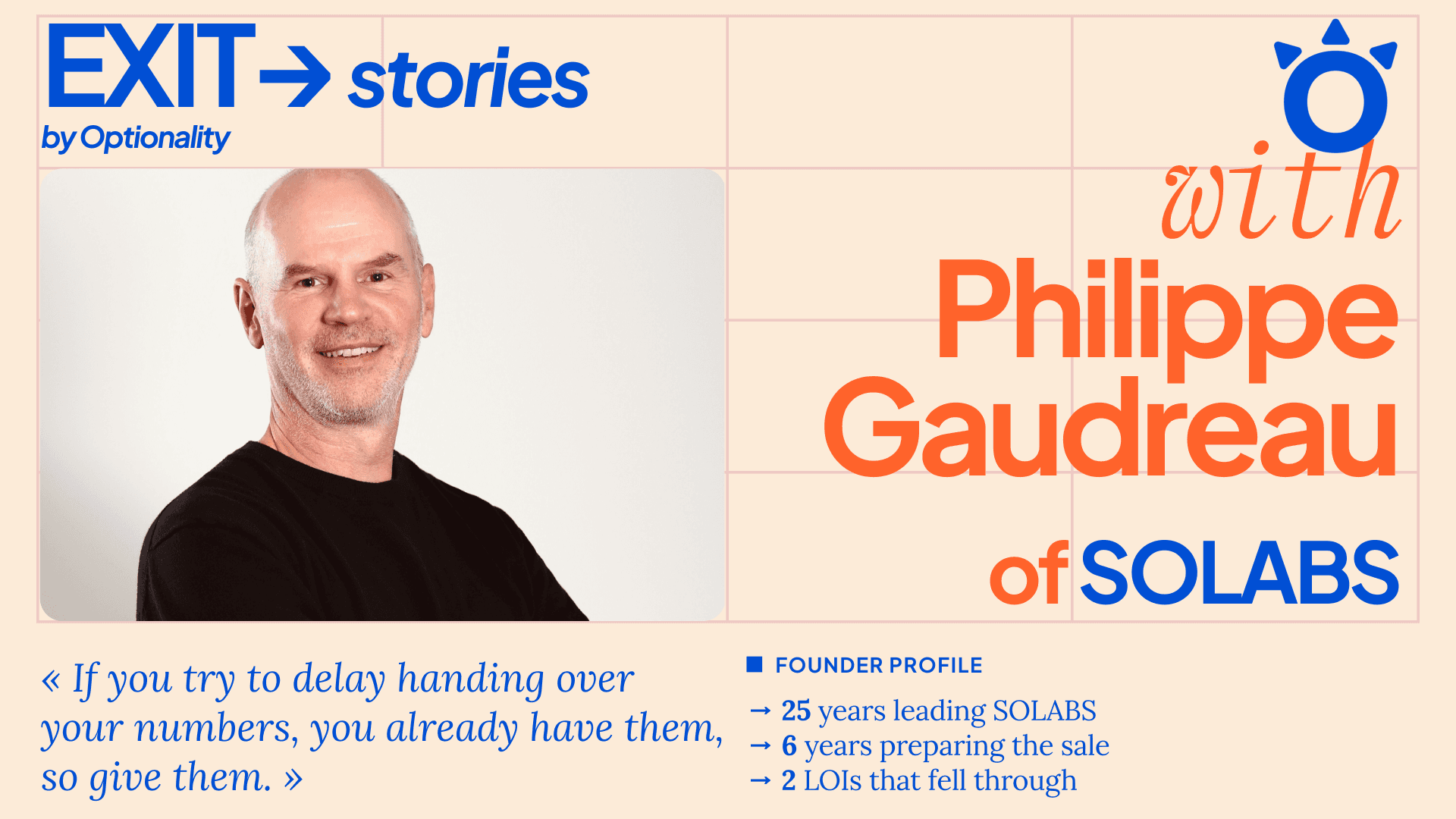
Lessons Learned From Selling Solabs (with Philippe Gaudreau)
For our fourth EXIT Stories, I sat down with Philippe Gaudreau, founder of SOLABS, an Enterprise Quality Management Software company for the life-sciences industry.
Philippe sold SOLABSin September 2025 to Oakline Holdings , fully closing in March 2026.
There was no splashy headline number.
What there was is more useful: a company that nearly died in 2009, rebuilt itself over years, and then engineered its own exit patiently, on its own terms.
That patience, and one unusual habit, are the heart of his story.
Here is what Philippe shared.
From chemical engineering to software
Philippe is a chemical engineer by training.
He was drawn to software early, partly because he is an entrepreneur at heart and software took little capital to start.
He also learned quickly that he was a better business analyst than coder.
His real strength was working directly with clients.
He founded the company that would become SOLABS in 2000.
For the first few years it did custom software development.
By 2005, work in the life sciences led to its first real product, a quality-management system, and its first paying client on a recurring revenue model.
By 2008, the company had a working quality-management product for life sciences and a dozen mid-size clients.
It also had a problem.
The product had been built piece by piece, and it did not scale.
Under a few large clients, it started to strain.
The desert crossing
2009 froze the economy, and the pipeline vanished in about three weeks.
Recurring revenue and financing secured just before the crash kept SOLABS alive.
Philippe made a hard call.
Rather than patch the old product, he would rebuild it from scratch.
The rebuild was supposed to take two years.
It took four to five. He calls it the desert crossing.
SOLABS relaunched in 2015.
Moving to the cloud then added a second layer of complexity Philippe admits he underestimated at first: cloud infrastructure, authentication, security, 24/7 support, and compliance scrutiny that life-sciences vendors live under.
By 2020, SOLABS had around 30 clients and roughly 5,000 users in a cloud environment.
Building the exit years before selling
Philippe started preparing to sell around 2019, with patient private shareholders and no pressure.
He knew these things take years. So he built relationships early.
And he did it with a habit I had never heard before: a quarterly financial newsletter.
Every quarter, he sent a short summary of the company's numbers to a list of funds and potential buyers. Anyone who reached out joined the list. The transparency did the qualifying for him.
If you try to delay handing over your numbers, you already have them, so give them. Whoever isn't comfortable won't reach out.
It cost little effort, and it worked.
It brought referrals and kept dozens of relationships warm
By 2021, it had turned into signed letters of intent.
Two deals that didn't close
Two of those early LOIs fell through.
One died over extensive criteria from a very large US fund. The process took 4 months and SOLABS reached let’s say 90%, where they were looking for 100%.
The other collapsed when the counterparty ran into financial trouble.
Philippe did not force it.
He paused, let the team breathe, let a few more years of growth strengthen the numbers and work on items that were flagged in the previous due diligence exercises. .
The newsletter kept running.
Choosing the buyer
By the time he reopened the process, Philippe already knew his options.
A strategic buyer was unlikely at his scale.
At SOLABS' size, it would take a strategic with $20 to $30 million in recurring revenue and a strong balance sheet, and those are rare.
Patient-capital investors was the realistic path, and he knew it cold: the model, the lower valuations, the trade-offs. That meant the process could move fast.
The buyer (Oakline Holdings) turned out to be a newly launched SaaS focused private equity fund, run by operators with deep experience from Constellation Software and similar businesses.
A newsletter recipient had reconnected them.
Joe, the fund's CEO, told Philippe in December 2024 that he would call once the fund closes.
He called in March 2025, and due diligence moved quickly from there.
Three things made it the right fit.
First, they already knew each other, so the go/no-go was quick.
Second, the fund's structure let Philippe roll a portion of his equity and stay on as a partner, rather than take an earn-out.
Third, Philippe trusted that Oakline would fully support SOLABS’ vision to become the best EQMS for small and mid-size Life Sciences companies.
SOLABS would be one of the fund's early platform companies, with a role for Philippe and his team to help build and acquire more.
He was candid about the considerations behind the decision.
With a few million in revenue, SOLABS was still a relatively small business in the eyes of financial buyers. While a strategic acquisition might have commanded a higher valuation, the shareholders placed greater importance on finding the right long-term partner.
Their priorities were clear: preserving the company's independence and continuity, keeping its talented team and R&D activities in Quebec, and creating the conditions for sustainable growth over the years ahead.
Lessons for founders
Win a few clients deeply before you scale.
SOLABS' first generation succeeded on closeness: the product was built alongside clients who became proud references, useful even across later product generations. The second generation sold broader and faster, and some of those clients were not the best fit. Get one or two clients genuinely happy first.
Price for the service you have to deliver, not for what the buyer might pay.
In software, the hidden costs are easy to miss.
Gross margin matters enormously. It isn't just whether someone will pay. It's whether they'll pay a price that lets you keep serving them well.
Bring finance in early, and know your own numbers.
Philippe, an engineer, taught himself finance by doing the first 2 levels of the CFA program, passing two of its three levels. But he also learned to stay in his zone of strength and surround himself everywhere else. By around ten people, he says, you need someone owning finance.
It's good to know a bit of everything, but you still have to pick where you're strong and stay there.
Build buyer relationships years ahead, transparently.
The quarterly newsletter let buyers qualify themselves, generated referrals, and kept relationships warm for almost no effort. Philippe would do it again without hesitation.
Know which buyer type fits your size.
Strategics are scarce for small companies. Patient-capital investors had the appetite, lower valuations and all. Matching the buyer to your reality saves months of wasted conversations.
Don't chase the last dollar at the cost of the mission.
Patient shareholders let SOLABS optimize for continuity, its team, and keeping R&D in Quebec. That shaped the entire process, from who they talked to, to the structure they chose.
A sincere thank you to Philippe for sharing the real story, the long build and the patient exit both.
Simon Leroux,
President, Optionality